Disclosure: BackSpin and Lewati were both built by Rizaldy Primanta Putra. The link to BackSpin in this article is marked nofollow. Earnings are not guaranteed and vary by usage.
The idle moments of AI-assisted coding
Coding with an AI assistant changes how the day feels. You write prompts, review generated changes, and wait. Every refactor, test run or repository analysis leaves a gap of ten seconds to a few minutes. Spread over a workday, that is a lot of fragmented time that most of us spend watching a cursor or switching tabs.
BackSpin is a project that tries to put those gaps to use. It describes itself as a discovery network for developers: while your editor is waiting on an AI response, it shows a small card with a developer tool, API or open-source project, and it credits you for verified attention-seconds. This article explains the model as BackSpin describes it, so you can decide whether it is worth trying.
How the attention model works
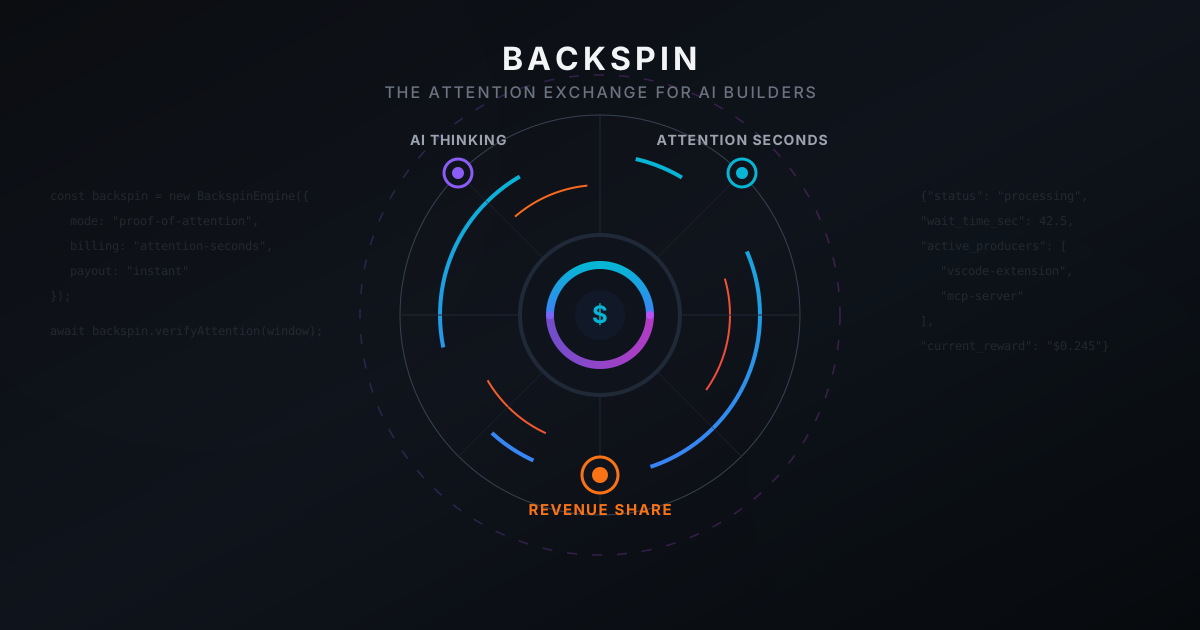
Traditional ad networks count impressions and clicks. BackSpin says it counts quality-adjusted attention-seconds instead: time during which the editor is in the foreground and you are present, discounted by an attention score. Advertisers pay for those weighted seconds, and part of that revenue is shared with the people who provided the attention. The exact revenue share and rates are set by BackSpin, so check its current terms rather than relying on a blog summary.
Technically it has two parts. A producer is any surface that can show an attention window, such as an editor extension, a terminal status line or a browser add-on. All producers feed one central service that handles scoring, billing, a ledger and rewards. BackSpin documents each integration on its own site.
Setup tips if you decide to try it
Place the panel where you can see it without covering your code. A narrow side panel works better than one that crowds the editor, and you can ignore the card entirely when you are focused.
Choose interest categories that match what you actually build, such as databases, hosting or security tools. The cards you see will be more useful to you, which is the point of a discovery network.
Keep expectations realistic. Rewards depend on how often you wait on an assistant and on campaign demand, so treat any figure you read, including on this page, as an example and not a promise.
Privacy questions to ask of any attention tool
Developers handle proprietary code and credentials, so any tool that watches editor state deserves scrutiny. BackSpin states that it does not read source files, track keystrokes or upload code, and that it only observes editor focus and wait-state signals. That is its claim; verify it yourself by reading the permissions the extension requests and its privacy policy before installing.
Good signs for any such tool are a clear off switch, a way to mute specific sites, reversible integrations and a public description of what data is sent.
Before you install anything that offers to pay you
Apps that promise payouts attract imitations, and invitation or referral links for them are often shared as short links. A short link hides the domain, so a lookalike site can pass as the real one.
Paste the link into Lewati first and read the real destination. Compare the domain character by character with the official one, check it with a safety lookup, and only then sign in. Never enter wallet seed phrases, API keys or banking passwords on a page you reached through a shortened link.