Disclosure: BackSpin and Lewati were both built by Rizaldy Primanta Putra. The link to BackSpin in this article is marked nofollow. Everything below summarizes what BackSpin says about itself.
A short answer to what BackSpin is
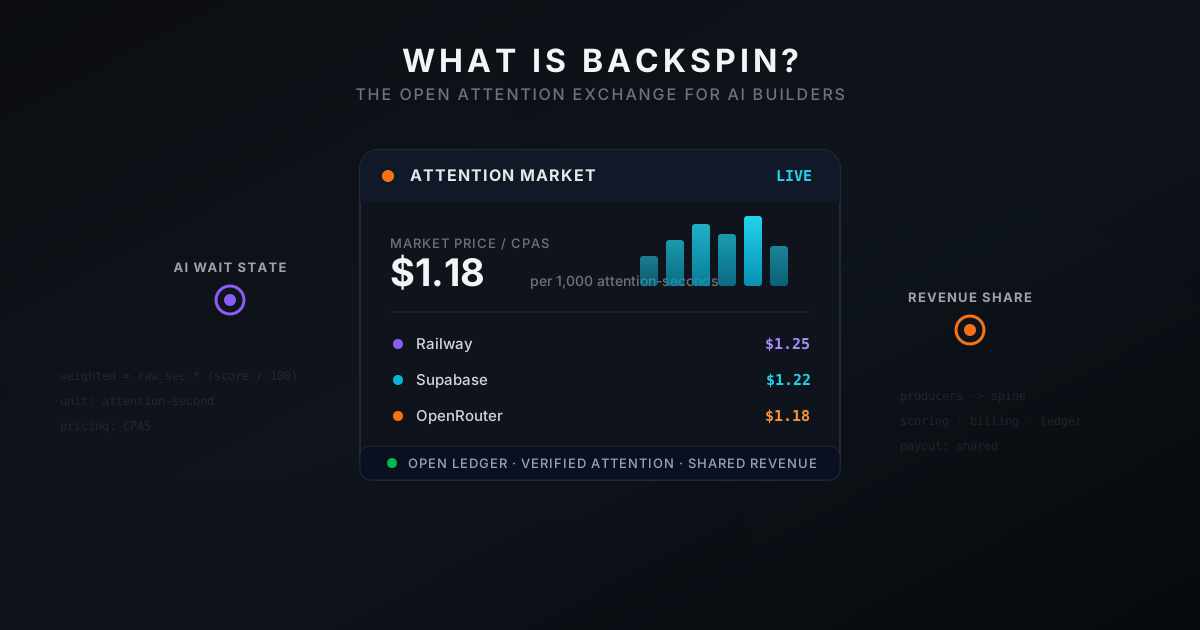
BackSpin describes itself as an open attention exchange for AI-native workflows. The pitch in one line: it turns the time a developer spends waiting on an AI assistant into verified attention that advertisers can buy and that developers share in.
It is not a classic ad network. In an AI editor you usually cannot click while a response is generating, so click-through rate is the wrong thing to measure. BackSpin instead sells quality-adjusted attention-seconds and share of voice across AI workflows.
Attention-seconds and CPAS pricing
The unit of inventory is the attention-second: a verified second of attention on a discovery card, discounted by an attention quality score. A half-noticed card counts for less than a fully engaged one, and only the weighted attention enters the market.
Prices are quoted in CPAS, the cost per thousand attention-seconds. Because the unit already accounts for quality, a CPAS figure can be compared across surfaces and campaigns. BackSpin says the market price moves with supply and demand, which makes it closer to an exchange than a fixed rate card.
Where it plugs in
BackSpin uses producers, which are surfaces that can expose an attention window, and one central service that handles scoring, billing, the ledger and rewards. Its stated rule is to reach each tool through the safest surface that tool already offers, without wrapping sensitive processes.
The first target is developer attention in AI coding tools such as VS Code, Cursor, Windsurf, Claude Code, Codex and similar. For editors it runs as an extension, for terminal agents as a status line hook, and for MCP-based agents as a server, with details in the documentation on its own site.
Openness and privacy claims, and how to check them
BackSpin says it publishes market price, aggregate supply, campaign share of voice and payout pools, and that allocation mixes an equal base share with a purchased boost rather than highest bid wins. It also says it does not read source files, track keystrokes or upload code.
Treat those as claims to verify, not facts established by this page. Read the public ledger and documentation yourself, review the permissions any extension asks for, and keep it off projects covered by strict employer rules unless your policy allows it.
A checklist for any tool that watches your editor
The questions are the same for BackSpin or anything similar. What data leaves your machine? Can you turn it off quickly? Is the integration reversible? Is the privacy policy specific? Who is paying, and how is the revenue split described?
One more habit worth having: sign-up and install links for new developer tools are often passed around as short links. Run them through Lewati to see the real domain before you download or sign in, and compare it with the vendor's official site.